Category: Stories

  • I Have The Right – A Hashtag Campaign for Students With Disabilities and Complex Learners

    I Have The Right – A Hashtag Campaign for Students With Disabilities and Complex Learners

    December 3rd was International Day of Persons With Disabilities. The theme of 2018 is “Empowering persons with disabilities and ensuring inclusiveness and equality”.

    December 10th is International Human Rights Day, and the 70th anniversary of the Universal Declaration of Human Rights, a milestone document that proclaimed the inalienable rights which everyone is inherently entitled to as a human being — regardless of race, colour, religion, sex, language, political or other opinion, national or social origin, property, birth or other status.

    Given the theme of empowering persons with disabilities, we felt it would be great for our students with disabilities and complex learners to have an opportunity to share their knowledge of their rights.

    It’s important for our children to understand their rights, and for them to learn to be self-advocates. We hope you’ll offer them this opportunity!

    We’re hoping to create a “viral” social media campaign, kicking off now and ending December 9th. It is very quick and easy to participate, and at the end of the day on December 9th, we’ll create a video compilation that will be shared December 10th, International Human Rights Day, compiling all of the images and videos with the hashtag!

    PLEASE NOTE that you will need to let us know that you consent to your image/video being added to the video compilation – send us a message with your consent to bcedaccess@gmail.com or a private message to any of our social media profiles @bcedaccess

    Simply ask your child if they would like to make up a sign about themselves, their rights at school, using the hashtag #IHaveTheRight

    For example:

    My name is Sushil
    I am a student in #bced
    #IHaveTheRight to learn in the same setting as my peers

    My name is Anita
    I love sports
    #IHaveTheRight to be a part of a team at my school #AllMeansAll

    You and your kids could do individual photos, selfies, a group photo, or even a brief video! Have fun with it, be creative, just be sure to use that “exact” hashtag #IHaveTheRight

    NOTE: This hashtag looks best when done case-sensitive as shown, and also makes it more accessible for those using text readers.

    Bonus hashtags:

    #bced will draw attention to the fact that this is about education in BC.

    #bcpoli – BC politics

    #AllMeansAll – inclusion hashtag

    #InclusionMatters

    #MentalHealthMatters

    INSTRUCTIONS FOR SHARING

    1. Share your photo(s) or video, and type whatever brief message you want in the post, ending it with #IHaveTheRight and the right your child wants to speak about

    2. Share on any or all of whatever social media accounts you have (i.e. Facebook, Instagram, Twitter, etc.)

    3. As you start seeing others appear, please “like”, “comment”, “share”, “Re-Tweet”, etc. theirs as well.

    4. IMPORTANT REMINDER: you will need to let us know that you consent to your image/video being added to the video compilation – send us a message with your consent to bcedaccess@gmail.com or a private message to any of our social media profiles @bcedaccess

    SOME EXAMPLES OF RIGHTS:

    https://plan-international.org/child-friendly-poster-convention-rights-child

  • Guest Post: How I Started an Inclusion SubCommittee Through my PAC

    Guest Post: How I Started an Inclusion SubCommittee Through my PAC

    How I Started an Inclusion SubCommittee Through my PAC

    A guest post by Chantelle Morvay-Adams

    ____________________________________________________

    I started an Inclusion Subcommittee at my school about a year and ½ ago. I set it up as a subcommittee of the PAC for a few reasons:

    1. Many in the PAC (and throughout the whole world, amiright?) did not really understand inclusion and no blame to them, they just didn’t get it. When you don’t have a kid with special needs or have never had your kid excluded it’s not automatic to think about Inclusion.
    2. I didn’t want to bog down the PAC meetings just trying to explain Inclusion. I wanted to be able to speak with like minded people to bring that mindset of Inclusion to everyone, including the PAC. I also felt like the PAC had good people doing good things. I didn’t want to upset that balance and I was fairly new to the school.
    3. As a committee made up primarily of parents (our librarian is also a defacto member and our principal attends most meetings) we have to be answerable to someone…and the PAC obviously was the best vehicle through which to bring our ideas forward.

    I set it up under the PAC. Which means there’s a process to creating this:

    1. You need terms of reference. Which sets out who you are answerable to, what your goals are and kind of how will you achieve those goals. My advice: keep how you achieve those goals general. You never know what direction your committee will go because every school is different.
    2. Put it on the PAC agenda and present it as a motion to create a subcommittee. Show your terms of reference. Bring the others who support this to explain what it is you are trying to accomplish.
    3. PAC votes on it. Hopefully it’s a go!
    4. Have monthly official meetings and invite everyone. (its about inclusion right? ) Our principal this year has been attending most of them-she has been a huge supporter. I am the chair, for now.

    Organize your meeting with an Agenda, and get someone to take meeting minutes. That way it’s transparent and then you report out to the PAC at the next PAC meeting. Keep the minutes simple-you don’t need to put everything said in your minutes, mainly things you have decided on. Your meetings need to be a safe positive space for all to attend. As chair you will be helping create that environment and making sure you don’t lose sight of the goals.

    We’ve been evolving since this first started. Our school is a great school but it has been a little tricky to get buy in from others besides our little group. Not that they are against it, it’s just they don’t know what they don’t know and it’s hard to communicate that when everyone is so busy. So we came to the conclusion that knowledge helps drive inclusion. We brought in an author last year who wrote a kids book on inclusion, Grayson Smith. Btw, worth looking him and his publishing company up “Peppermint Toast Publishing”, an amazing company.

    But we wanted something more.

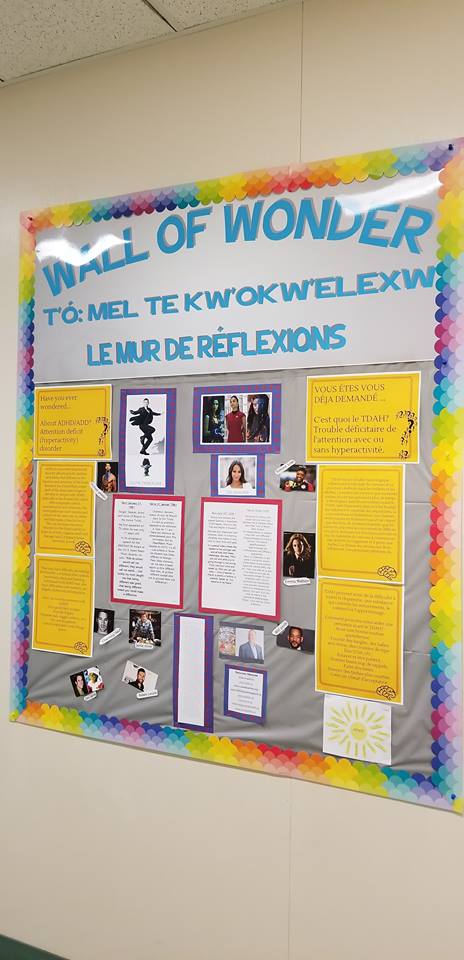
    So a parent came up with a WALL OF WONDER. Each month is a new awareness month. So this year, we are doing ADHD, diabetes, kindness and compassion, autism, epilepsy, mental health etc. ….. stuff like that. Stuff that isn’t necessarily specifically taught in the class but kids wonder about. There was also the idea of a monthly newsletter etc…but for now this is what WE found to be what we could do. Our Wall of Wonder is a source of pride for us parents and we’ve been getting feedback from the kids who say they like seeing the celebrities. We also have the Wall of Wonder Translated into 3 languages: English, French and Halkomelem. Halkomelem is the language that was used in the past here and almost died out. Our school district is on the unceded territories of the Leq’á:mel, Matheqwí, Qwó:ltl’el and Sq’éwlets peoples. As language is a part of a persons culture, we here in Mission get to honor and grow that language and culture by having it taught in our schools to all of the students.

    wall of wonder

    So remember every school is different….with different needs and access points.

    You have to find what works for your school and what you as parents are willing to do. You also need buy in from the principal. That is not a deal breaker….but It’s been much easier with a principal who supports us.

    Good luck to all wanting to start something like this. Sometimes it can be difficult when those you are trying to convince don’t seem to understand. What helped me get through the first bit…and still does to be honest when I try all new things. I think of Bruce Lee, I know sounds weird. We are not really fighting…but we kind of are, aren’t we?

    “You must be shapeless, formless, like water. When you pour water in a cup, it becomes the cup. When you pour water in a bottle, it becomes the bottle. When you pour water in a teapot, it becomes the teapot. Water can drip and it can crash. Become like water my friend”

    ….and to me, water…it can shape mountains. ;)

  • Tracking Exclusion: Interim Report

    Tracking Exclusion: Interim Report

    Since September 4th, 2018, BCEdAccess has been collecting data on the exclusion of students with disabilities from schools in BC. It is our intention to highlight some of the systemic issues so that districts may start looking at this data themselves and work on solutions.

    TRACKING EXCLUSION: BCEdAccess’ Exclusion* Incident Report Form

    In this, our first interim report, we note that all grades, from K-12, are represented by survey respondents. Here are some of the findings so far:

    Districts:

    35 out of 60 districts have reports of exclusions

    What does this mean? It’s hard to say, but probably this is more about the survey’s reach than anything. If we were to do more outreach in the unrepresented districts we might see more exclusion. What it does tell us is that this is not an issue that’s isolated to only a few districts. Some of the more populated districts have a larger piece of the pie chart, but this could be due to over-representation – it’s hard to ascribe the results to any one district having more or less successful outcomes.

    The takeaway? It happens everywhere, in urban and rural districts, it’s not rare and it’s not unusual.

    How many people?

    As of this writing we’ve had 228 reports. But this doesn’t tell the whole story.

    The majority of the submissions are a single report documenting repeated instances of exclusion. In future surveys we will need to add something to the design to allow better tracking of this.

    We made the attempt to tally the single instances of daily exclusion. It was difficult to be precise, but the number is over 1200.

    What kind of schooling?

    96.8% public school and 3.2% independent school

    For comparison, overall independent school enrollment is 12.9% of all students in BC.

    Is your child designated?

    5.4% of respondents said their child is waiting for assessment.

    What are the designations of the other 94.6%? Highly varied.

    Categories A, C, D, E, F, G, H, P and Q all represented

    Category descriptions:

    • Level 1
      • Physically Dependent (A)
      • Deafblind (B)
    • Level 2
      • Moderate to Profound Intellectual Disability (C)
      • Physical Disability or Chronic Health Impairment (D)
      • Visual Impairment (E)
      • Deaf or Hard of Hearing (F)
      • Autism Spectrum Disorder (G)
    • Level 3
      • Intensive Behaviour Interventions or Serious Mental Illness (H)

    H (Students Requiring Intensive Behaviour Intervention) has by far the highest representation at 65.4%

    How much time was missed?

    This was very well covered by BCCPAC in their report of last year. They surveyed over 800 parents and documented clearly just how much educational time has been missed by students not attending full days of school. Here is their report:

    Students With Special Needs Not Attending Full Days

    Here’s how it looks so far in our survey:

    hours of exclusion

    This pie chart requires some discussion. By far the largest category is ‘Other’, at 35.7%.

    All but 2 of those who chose “Other’ indicated they chose it so that they could cite either multiple days of exclusion, or an issue that is continuous and ongoing.

    This leads into why children are being excluded. Below is just a sampling of the types of exclusion cited.

    There are multiple examples of each type of exclusion listed:

    -Being asked not to bring their child for the first one to four weeks of school

    -Is only allowed to attend 2 hours per day

    -Is not allowed to attend until there is an EA in place

    -Missing a half day weekly

    -excluded because of bullying or other safety concerns

    -If parent can attend, child can attend, but if not, child cannot attend as there are no supports

    -can only attend a short part of the day; no plans to extend the time because there is no staff

    -Not enough funds to support child full time

    -Excluded from every field trip so far

    -Excluded from all extra-curriculars

    -Excluded from course because the course materials are not adapted

    -Excluded from elective high school courses

    Often we hear from school districts that these exclusions are mostly agreements with parents. I suppose they can say this because parents often do agree. Here’s the thing, though:

    a) Most parents don’t know it’s an option to refuse, and b) Many parents cited feeling ‘forced’ into agreeing to the exclusion, and only some of them are actually appealing the decision. In the main, parents are more apt to try to work collaboratively with the school, in the meantime disrupting things at home to find a way to make these shortened days or unexpected exclusions work.

    Was the child’s usual support personnel absent?

    personnel absent

    We had expected to see here that the most common answer was yes.

    In fact, the two biggest answers were ‘No’, and “My child has no usual support personnel’.

    What this tells us is that the usual staff are there, there just aren’t enough of them. And that 35.1 percent of children being excluded have no support personnel at all.

    Was your child physically restrained?

    Inclusion BC has done 2 reports on this issue at this point – Stop Hurting Kids 1 and 2. Read them here:

    Stop Hurting Kids

    Their surveys indicate that not only does seclusion and restraint happen alarmingly frequently, but that there has been no great change over a 5 year period. This requires urgent attention.

    Our survey shows, so far, that 4 percent said yes, their child was restrained.  That’s 9 children (out of 228) too many.

    Also worrying is the 19.2% of respondents who said ‘not sure’. With some children being nonverbal or having other communication deficits, it’s hard to know for sure what is happening at school.

    Is there anything else you would like to include?

    There was a great deal that respondents wanted to add. Many were more specific descriptions of the circumstances of their child’s exclusions. Some took the time to say how important the relationship with the school team was to them, and they expressed their fear of jeopardizing that by complaining. Mental health concerns feature prominently.

    At the beginning of the school year and even as recently as last week, respondents are still waiting to hear about potential supports for their children – EAs and also technical supports, programming, and learning resources.

    I’m going to finish up this report with just a few of the quotes from the 228 respondents. They speak for themselves.

    “When I dropped my child off at school, I was asked to take them home, because my child is Deaf-blind, and there would be no one there with my child”

    “My child has never had any real education”

    “I think it sucks they don’t have placement for kids who need assistance until the second week, which basically forces the parents to keep the child home until they have a placement”

    “They left it up to me to send him or not which is wrong. I would not be a responsible parent if I were to set him up for failure. But they seem to be taking their time and leaving the follow up to me which is wrong as well.”

    “Desperate to find an advocate to convince the principal together with me, with the experience of special need rights to deal with the the principal.”

    “According to school staff they are not funded enough to support our son full time.”

    “Just because a child is well behaved in the classroom doesn’t mean he should miss out or be left to flounder academically in the classroom”

    “We’ve been told there is only enough funding to support my daughter with an EA 50% of time”

    “This family is under severe strain and I am very worried about them.”


  • AccessAbility Week 2018

    AccessAbility Week 2018

    I had the privilege of being invited as a guest of Inclusion BC to see Minister of Social Development and Poverty Reduction, Shane Simpson, declare AccessAbility Week at the Legislature in Victoria earlier this week. I felt very humbled to be among such long-serving disability advocates and completely re-invigorated to keep up the work of our group.

    There are some good things afoot in our province.

    From the BC Government website:

    “Government has a vision to make BC a truly inclusive province by 2024. This vision is designed around 12 building blocks. They reflect what was heard from British Columbians during the province-wide disability consultation.

    Being truly inclusive means:

    • Providing people of all abilities with the opportunity to fully participate in their communities
    • Challenging our attitudes and beliefs about disabilities
    • Recognizing the value and contributions that people with disabilities make to our workplaces, communities and economy

    Approximately 15 per cent of British Columbians over 15 years old self-identify as having a disability. Our goal is to prevent and remove barriers so everyone can participate and feel included. This way, B.C. will be a better place to live, work and visit for everyone.”

    Read more about what the BC government is doing

    Meanwhile, across the Atlantic Ocean, Inclusion International and Inclusion Europe have been holding a conference over the last few days in the UK, and I have been following with interest on Twitter. From their website, “The event brings together self-advocates, families, and professionals to:

    • learn and share experiences from around the world about issues and challenges faced by people with intellectual disabilities and their families as well as strategies that have been successful in achieving change
    • inspire and be inspired by successes and innovations for inclusive practices
    • lead the way as a global movement in promoting inclusive communities.

    Twelve years ago, the Convention on the Rights of Persons with Disabilities was adopted. In 2015, the world adopted the Sustainable Development Goals. Now, we are closer than ever to achieving our vision of inclusive communities worldwide.”

    The tweets I have been reading show how powerful it can be when self-advocates and allies get together. I would love to attend one day!

    Families in our group aim to teach our children to be self-advocates as an important life skill, and I personally learn every day by following self-advocates on social media.

    I wanted to share the Calls To Action that came out of this conference because they are so important, and they apply to all persons with disabilities and diverse learners. And because it’s National Accessibility Week, and access is for everyone.

    Being a part of the community

    Being valued equally

    Meaningful employment

    Inclusive Education

    Closing Institutions

    Those are some strong pillars to have as foundations for a movement!

    I know that our members are very much a part of this movement. We would expand the Inclusive Education call to action to include all children with complex learning needs, and education advocacy is our group’s main focus, but all of the above Calls to Action impact and matter to our member families.

    I’ll end this post, and celebrate National Accessibility Week, with one more tweet:

    Why speak out?


  • The state of things

    School has been back in for 2 1/2 days as I write this update in September of 2017.  I wish I didn’t have too much to say but unfortunately it hasn’t been a super great week for some kids in BC schools.

    What’s been happening, you say?  Here is an incomplete list:

    Parents are being asked to keep their children home in large numbers, while classes are organized and set, and often while EA’s are still being assigned and/or hired.

    Parents have been told their child may only attend a portion of the day, sometimes as little as 1 hour, and sometimes temporarily but in some cases, for the entire year.

    Parents have discovered that their children are not on track to graduate with a Dogwood – their program has shifted without consultation or explanation.

    Students new to high school are already getting lost in the shuffle – their IEP accommodations have not been passed on to their new teachers, and assignments are not being approached with regard to their needs.

    Parents have been told that assessments are on hold, or that their child will not even be recommended or waitlisted for one at this time.

    Parents are already struggling with trying to hang on to their jobs as schools are calling them to pick up their child during the school day, because there are no supports available for them.

    Parents are already being told that their children will be excluded from field trips, band, sports and other activities.

    Parents, having been reassured before school started that the right supports would be available for their kids, have arrived at school to find that those supports are not there.

    I have been hesitant to dampen the enthusiasm and energy of the new school year. There have been some really positive changes. But I can’t help feeling that kids are being left behind again.
    Inclusion and students with special needs are the afterthought of the BC school system. These issues need to be urgently addressed. Our kids have waited long enough.
  • Unread Pages

    We are privileged to share this poem that was written by the son of one of our group members. It is an important reminder that we need to be curious, to see our kids for who they really are. Thank you so much for sharing your message, Brody.


    Author: Brody Butts

    UNREAD PAGES

    I am not perfect
    Some of my pages are torn
    Some are soiled with ink
    Some pages are worn and creased
    Some are crisp and clean.

    I am solitary
    Some of my pages hold my secrets and thoughts
    Others are meant to be read out loud
    Hundred of pages and thousands of words
    All contained in 1 book.

    I am intelligent
    Some sentences make sense right away
    Others you need to read twice
    And others you need to read between the lines
    But to me, those are my favorite.

    I am unique
    My pages and chapters are written by me
    My experiences are my own
    I am my own editor, you can not change me
    My ink is permanent and my spine is straight.

    I am creative
    My illustrations are different then you may think they should be
    That’s because I see things differently.
    I create from what I experience and see
    And mold it into something I understand.

    I am misjudged
    I am judged by my cover not by my pages
    I have a hard blank cover, not telling what’s inside
    My pages are soft to the touch and full of wonder
    If you take time to read me, you will see.