
Children can spend years waiting to have their disabilities understood, only to discover that documentation is no guarantee of support.
Over the years, BCEdAccess has heard from families and caregivers struggling to obtain psychoeducational assessments at every stage of their children’s education. Most often, these accounts begin in elementary school: a child is struggling, their parents or caregivers are asking for help, and further investigation remains out of reach. Families and caregivers describe repeated rounds of intervention, monitoring, and meetings, while their children’s learning challenges remain unresolved.
Families and caregivers describe children becoming increasingly distressed, losing confidence, disengaging from learning, or becoming unable to attend school. By the time some students reach secondary school, the challenge is no longer simply identifying appropriate academic supports, but rebuilding their connection to education.
For students who have managed to keep going and hope to attend university or college, access to assessment can remain a barrier. Families and caregivers seeking to document the supports their children will need encounter another explanation for why an assessment may not be available: psychoeducational assessments are prioritised for younger students.
When scarcity becomes the rule
Burnaby’s school psychology website illustrates how scarcity has become embedded in the way access is explained to families and caregivers. Its pre-referral guidance states that “the number of requests for assessments usually far exceeds the number of assessments a school psychologist is able to do” during a school year. Every request must pass through the school-based team and onto a pre-referral list before a psychologist decides whether formal assessment is recommended.
Its FAQ explains that assessments sought for post-secondary accommodations “are not usually completed due to heavy demand for psych-eds and large caseloads”. Although exceptions exist, the stated priority is planning supports within Kindergarten to Grade 12.
The significance is not simply that resources are limited. Insufficient capacity is presented as a routine condition around which families and caregivers must organise their expectations. A decision that an assessment is unnecessary is different from a decision that the system cannot provide it. Families and caregivers deserve to know which decision is being made, what evidence supports it, and when unresolved needs will be reviewed.
Children should not spend their early school years waiting for their learning differences to be investigated, only to approach graduation and find that preparing for their next stage of education is a lower priority.
When families and caregivers with financial resources can purchase assessments privately, while everyone else must navigate these restrictions, scarcity becomes an unequal barrier to understanding and documenting disability-related educational needs.
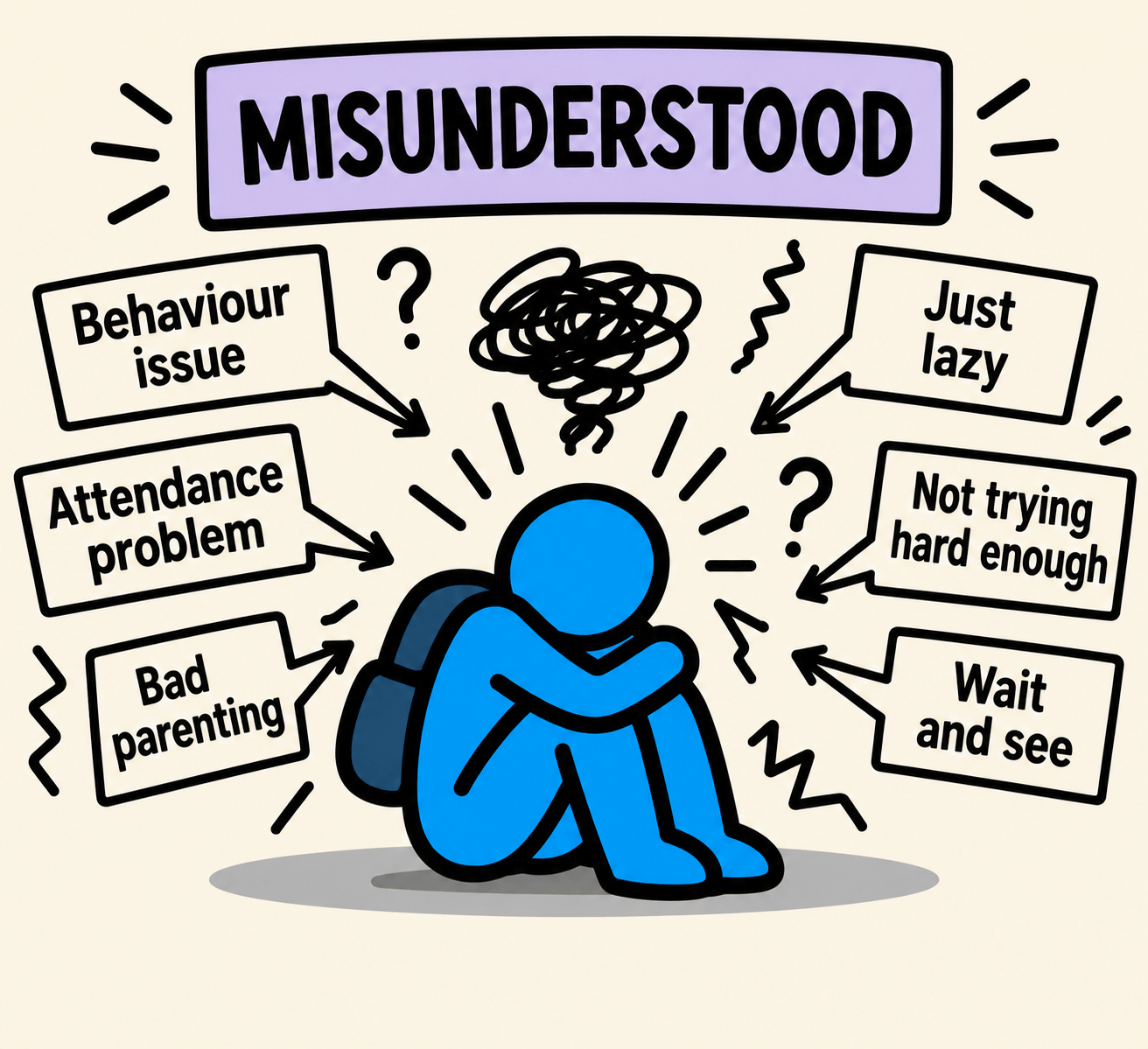
The first gate: misunderstood and forced to wait
Not every child needs a specialised assessment. It makes sense to try different teaching approaches, observe what helps, and adjust. The Ministry’s Inclusive Education Services Manual describes that process: observation, intervention, consultation, and, where appropriate, more specialised assessment.
But “intervention first” must mean actual intervention—not another reason to wait.
If whole-class instruction is not meeting a child’s needs, the response might include individualised or small-group teaching, more hands-on instruction, or presenting one question at a time. The approach should respond to the child, be put into practice, and be reviewed to see whether it helps. Repeating the same instruction while waiting for a different result is not a meaningful intervention.
Gatekeeping occurs when children are told to wait for assessment while the support supposedly justifying that wait is inadequate, inconsistent, or absent. Families and caregivers are left trying to fill the gap, while the school continues to describe the child as being monitored.
Meanwhile, the explanation can shift from what the school has not provided to what is supposedly wrong with the child. Not trying hard enough. A behaviour issue. An attendance problem. Bad parenting. A child who cannot sustain attention in an inaccessible classroom becomes a motivation problem. A child overwhelmed by unmet needs becomes a behaviour problem.
These explanations turn unmet support needs into personal failings. The child becomes the problem, and the adequacy of their education escapes scrutiny.
An assessment can clarify disability-related needs, but its absence does not suspend the responsibility to respond. The BC Human Rights Tribunal explains that service providers have a duty to inquire when they know, or reasonably ought to know, that a negative effect may be connected to disability.
Families and caregivers should be able to ask:
What support is being provided now, who is delivering it, and how will we know whether it is working? If barriers remain, when will further assessment be considered?
A school cannot meaningfully justify delay by pointing to interventions it is not delivering. If capacity is insufficient to provide either timely assessment or effective support, that is a gap in public provision—not evidence that a child is lazy, a caregiver is failing, or more waiting will solve the problem.
Imagine spending years being told you are not trying hard enough when the adults around you have not figured out what you need to succeed. By the time an assessment explains what has been happening, a child may have spent years internalising the idea that they are the problem.
How scarcity became part of the system
In December 2001, Burnaby primary teacher Megan Hardie went before the Legislature’s education committee and described children waiting two or three years for psychoeducational assessment. Specialist support was already stretched incredibly thin.
“That really frightens me, as a teacher, to be completely honest,” she told the committee. Hardie warned that freezing funding and removing classroom protections would make things worse.
The following year, Gordon Campbell’s BC Liberal government, with Christy Clark as education minister, stripped negotiated protections governing class size, class composition, and specialist staffing. A funding freeze, combined with salary increases districts were required to absorb, forced school boards to cut services. The system had been struggling to meet children’s needs. The decisions that followed made that work harder.
The government presented greater local discretion as part of the solution. Its March 2002 funding announcement promised “more flexibility, autonomy and control”. Supplementary grants, apart from Aboriginal education funding, would be unconditional. Clark said “locally elected trustees are best able to identify and manage those priorities.”
But a disabled child’s access to education should never have to compete for the status of a local priority.
Local knowledge can help schools decide how to meet a child’s needs. It cannot make meeting those needs optional. Giving districts greater control over scarce resources did not provide the specialists children were waiting for. It gave districts more discretion over where the shortages would fall.
By 2007, Burnaby parent Delphine McIntyre was describing what that waiting had meant for her son. She told the Georgia Straight that concerns had been apparent early, but he was not assessed until Grade 4, when his behaviour became difficult for the school to manage.
“It took five years,” she said.
Her daughter was also experiencing distress at school and remained unassessed. McIntyre challenged the suggestion that the problem lay entirely within her child: “I say the manner of teaching is creating the anxiety.” Her account appeared in an article titled “Provincial government fails learning-disabled kids”.
Five years is a substantial part of a childhood. It is time spent trying to learn, trying to belong, and trying to understand why school feels so much harder than it seems to for everyone else.
Staff tried to hold the system together. In 2011, former education assistant June Kaiser described assistants taking on additional planning work “because sometimes if they don’t do it, there are no plans.”
That willingness to keep going could not replace the support being lost. By 2015–16, specialist teacher positions had fallen by approximately a quarter since 2001–02, according to the BC Teachers’ Federation’s funding brief.
The stripped provisions were eventually restored through the 2016 Supreme Court decision, followed by an implementation agreement in 2017.
A child entering Kindergarten when those protections were removed could have finished secondary school before they returned—if they had managed to stay in school at all.
A public system with a private escape route
In British Columbia, we take pride in public systems built on the principle that access to essential services should depend on need, not ability to pay. Yet families and caregivers seeking psychoeducational assessments can face a different reality: what feels like a lottery for assessment through the school, a private service they cannot afford, or a charitable application with income restrictions.
BCEdAccess repeatedly hears from families and caregivers pressured to pursue private assessments despite making clear they cannot afford costs of around $3,000-4,000. Some stretch already strained finances because their child is struggling and they see no alternative. Others simply cannot. Directing families and caregivers towards private assessment shifts responsibility for gaps in public provision onto parents and caregivers, leaving children’s access dependent on whether their families and caregivers can find the money or resources.
Charities such as Variety BC help fill this gap, but eligibility is restricted. Variety currently considers grants for households with total net income of up to $85,000, subject to other requirements and funding availability. A family with net household income of $90,000 may not qualify, but that does not mean it has several thousand dollars available. Even eligible families and caregivers must complete another application and gather supporting documents. That work takes time and energy too.
Some children never receive an assessment. Their learning differences remain unexplained while they continue to struggle. Years without appropriate understanding and support can erode confidence, undermine trust in school, and contribute to disengagement from education.
The existence of a service is not the same as meaningful access to it. A public system must be judged not only by the children it assesses, but also by what happens to those it leaves waiting or never assesses at all.
This is a form of privatisation: the public service remains, but responsibility for overcoming its gaps falls to families and caregivers, with charities helping where they can. Private spending and charitable funding can help individual children while making unmet public need less visible. The question becomes how resourceful a family can be, when it should be how the system will ensure their child’s needs are understood and addressed.
A waitlist to be on the waitlist
Vancouver School Board’s April 2025 financial planning document reports 17.6 budgeted full-time-equivalent psychologist positions as of April 2024. Across approximately 50,000 K–12 students, that is roughly one budgeted psychologist position per 2,800 children.
The district says that once a psychologist determines further diagnostic assessment is required, it is completed within that school year. This presents a reassuring picture: a psychologist identifies the need, and the child receives an assessment.
But how does a child reach that psychologist?
At that staffing level, psychologists depend heavily on other staff to bring children’s needs to their attention. Southlands Elementary’s 2021 inclusion policy, describing VSB support processes, makes that earlier decision explicit:
The services of a School Psychologist are accessed through the School Based Team. After discussion of the teacher’s or parent’s concerns, the school based team determines if the School Psychologist’s services are required and sets priorities for this service.
The psychologist decides whether to proceed with an assessment after the school-based team has helped determine whether the child reaches them at all. Naming the psychologist as the decision-maker leaves that earlier gate out of the picture.
VSB states that its psychologists do not keep assessment waitlists. School-based teams may instead maintain monitoring lists while interventions are tried and information is gathered. For a child whose request remains unresolved, that can mean waiting to reach the point where the district starts counting.
In April 2024, then education minister Rachna Singh told the Legislature: “We don’t have any provincial wait-lists for the psych-ed assessments.” She explained that districts made decisions locally according to students’ needs. But local decision-making does not establish that enough assessments are available—or account for children still trying to be considered.
When capacity is limited, we need to know whether referral decisions reflect a child’s need for investigation or the number of assessments the system can provide. Without recording requests and reasons for decisions, those distinctions remain hidden. So can gender stereotypes, racism, assumptions about poverty and parenting, and differences in families’ and caregivers’ capacity to keep advocating.
We need a transparent waiting list that begins when an assessment is requested, including by parents and caregivers. Requests should follow a documented process with clear criteria, recorded reasons for approval, deferral, or refusal, and review dates. Families and caregivers should be able to see where their child stands and seek reconsideration.
Children should not have to secure approval before their waiting counts. Until the system accounts for everyone seeking assessment, a reassuring completion timeline can conceal the very shortage it appears to resolve.
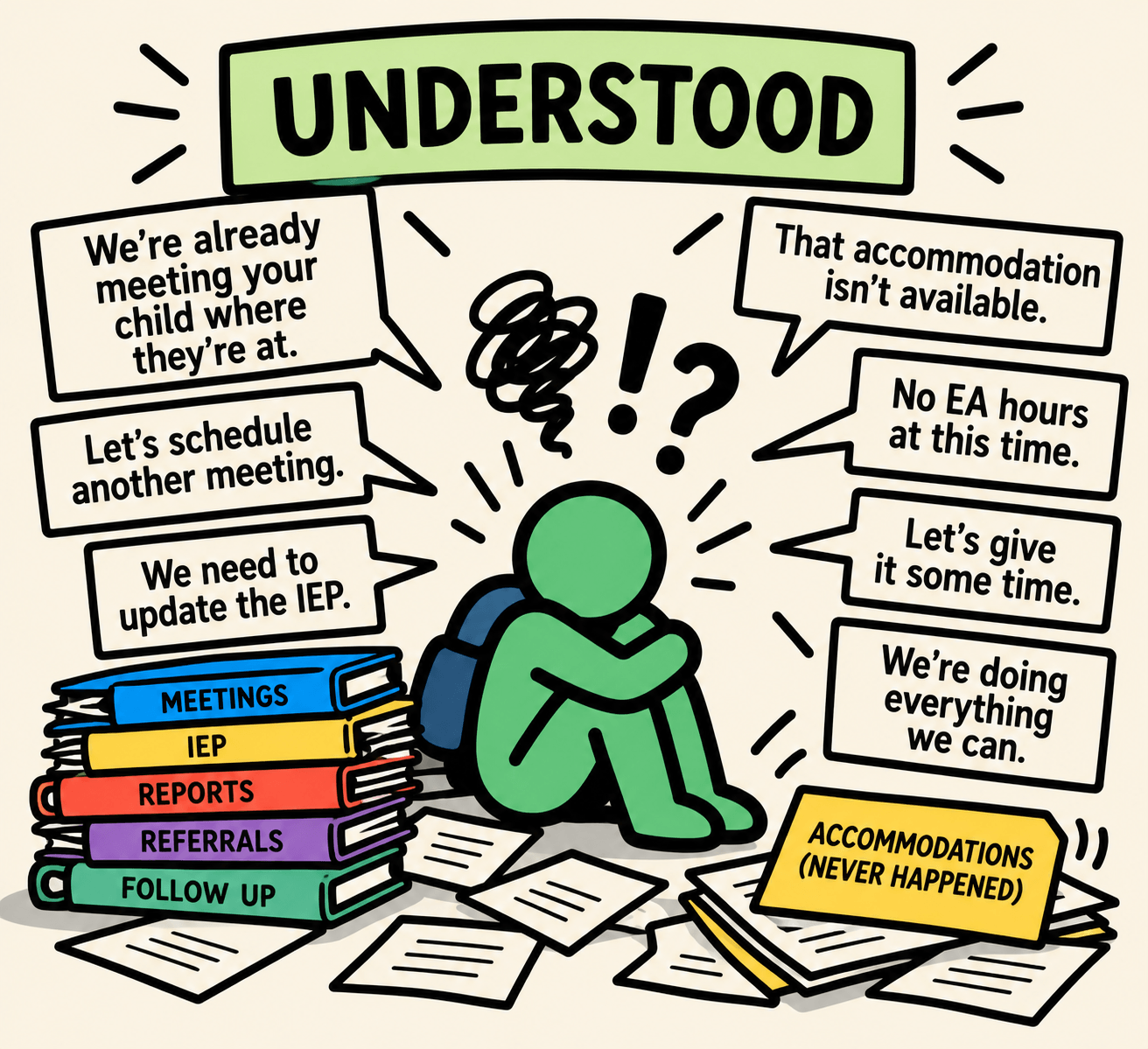
The second gate: understood, but still unsupported
Through BCEdAccess, I hear from families and caregivers who have invested enormous hope in an assessment. They have waited, advocated, and sometimes paid money they could not afford. When the report finally arrives, its recommendations may reflect strategies they have been asking the school to try for years, while their knowledge has been doubted.
There can be such relief in that moment. Finally, someone understands. Finally, there is a way forward.
Then comes the heartbreak of discovering that the report has not opened the door to support.
An accommodation is unavailable. There are not enough educational assistant hours. The school says it is already meeting their child where they are at. Sometimes support begins, a child makes progress, and then it is withdrawn because they aren’t failing enough to qualify.
Imagine what that asks of a parent or caregiver: to watch their child lose access to something that helped, then wait for them to fall behind to receive it again. Progress made with support does not establish that a child can learn without it.
The assessment was supposed to end the struggle to have their child’s needs recognised. Instead, it becomes evidence they must keep presenting in a struggle to have those needs met.
The law gives families and caregivers reason to expect more. Schools have a duty to accommodate disability-related needs to the point of undue hardship. That duty can arise before a formal diagnosis. Where a school relies on undue hardship to justify withholding accommodation, it must substantiate that position. A general statement that resources are limited is not enough.
Yet scarcity is repeatedly presented as the final answer: these are the hours available, these are the eligibility criteria, this is all the school can offer. The existing allocation becomes the ceiling on support, without an explanation of why providing more would cause undue hardship.
Meanwhile, families and caregivers are asked for more evidence. Obtain the report. Document the barriers. Explain what happens without support. This is a documentation asymmetry: the child’s needs undergo repeated scrutiny, while the institution’s assertion that it cannot do more may escape comparable examination.
Another meeting is scheduled. The IEP is updated. Everyone agrees to monitor progress. These steps can be useful, but when they produce no change in the child’s school day, process has substituted for access. The file records activity, while the child is still waiting for help.
Even support that finally works can disappear in September. A new team wants to observe the child before continuing accommodations. Families and caregivers explain the disability again, describe the barriers again, and ask for what was already helping in June, while the child misses weeks of meaningful access to education.
For the adults, this may be a new school year. For the child, it is another experience of being left without what they need. The losses accumulate: learning interrupted, anxiety heightened, confidence eroded. A child may stop trusting that adults will help, or begin to believe that their inability to cope is a personal failure.
Families and caregivers keep pushing because they see those consequences. But not every child has an adult who can keep taking time off work, documenting harm, and challenging refusals. Exhaustion does not mean the need has been met. Silence does not mean the child is doing well.
Schools and districts must take responsibility for delivering accommodations, maintaining effective support across school years, and explaining how needs will continue to be met.
Children’s rights cannot depend on having someone who can fight indefinitely. An assessment should help secure an education—not a permanent obligation to prove, again and again, that a child deserves access to it.
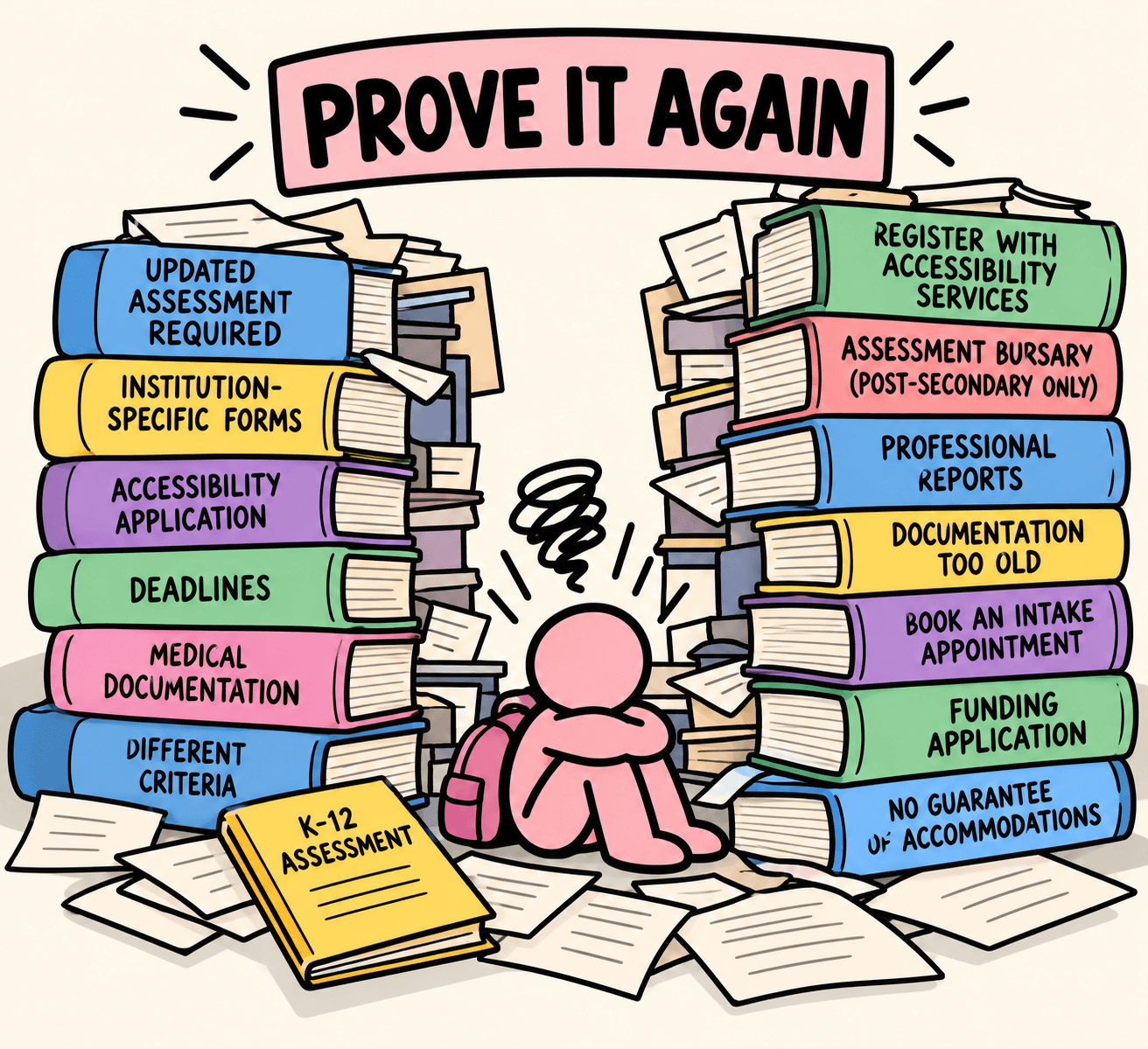
The third gate: prove it again
After everything it has taken to get this far, a young person is looking towards university or college. There is something they want to study. A future they want to build. Their families and caregivers begin to hope that the support they fought for through school will provide a foundation for what comes next.
Preparing for that future is part of the school’s work. Section C.3 of the Ministry’s Inclusive Education Services Manual includes planning for further education and the supports disabled students will need beyond school.
A recent psychoeducational assessment can be essential to securing accommodations for a learning disability in post-secondary education. SFU requires an assessment completed within five years of university entry or as an adult over 18, while UBC Vancouver’s published standards say the report should be no more than three to five years old, with testing completed at age 17 or older. An assessment obtained in elementary school may therefore need updating just as a student prepares to take the next step in their education.
Meanwhile, Burnaby’s guidance says reassessment is “not done automatically or routinely for most students”. Families and caregivers can find themselves seeking another assessment even though the student’s disability has long been recognised.
The young person has worked towards a future that their education was supposed to prepare them for. Now, at the threshold, they may discover that documentation is another barrier.
StudentAid BC offers a Learning Disability Assessment Bursary of up to $3,500. Its published eligibility criteria include enrolment at a designated public post-secondary institution in BC, eligibility for StudentAid BC funding, and a recommendation from the institution’s accessibility services office. Students are directed to contact the institution they plan to attend. This can help, but it does not provide a universal route to updated documentation while a student is still in secondary school.
Transition planning must address foreseeable documentation barriers early enough for students, families, and caregivers to act on them. A young person who has worked so hard to reach this point should be choosing what they want to study, not wondering whether they can afford to prove, once again, that they need support to learn.
Assessment is not access. Documentation is not accommodation.
In Moore v. British Columbia (Education), 2012 SCC 61, the Supreme Court of Canada made clear that disabled students are entitled to meaningful access to education. Special education services are how schools make that access possible. The measure of success is whether a child can participate and learn—not simply whether the school has assessed them or written a plan.
That is the promise running through every gate in this story. An assessment should lead to understanding. Understanding should lead to support. That support should remain dependable as a child grows, changes classrooms, and prepares for life beyond school.
Instead, families and caregivers can spend those years trying to secure what the system has already acknowledged their child needs. The costs of insufficient provision become private assessment bills, lost working hours, exhausted caregivers, and children losing confidence that school is a place where they belong.
As British Columbia approaches its next provincial budget, we must be clear about the starting point: the existing level of provision is already leaving children without help. Preserving it would preserve those failures.
BC needs sufficient publicly funded assessment capacity and a transparent record of requests from the day they are made. Children need support while they wait. Decisions to defer or decline assessment need reasons and review dates. Identified accommodations need to be delivered, maintained across school years, and reviewed for whether they actually remove barriers.
The province must fund these responsibilities and hold districts accountable for fulfilling them. Local discretion must operate within children’s rights. Those rights cannot depend on winning a budget debate or having someone who can advocate indefinitely.
Behind every assessment request is a child with interests, relationships, and a future still taking shape. Families and caregivers keep asking because they can see what is at stake.
Children have one childhood. They should be able to spend it learning, belonging, and discovering what is possible—with support they can count on.

Leave a Reply