Tag: Covid-19

  • 8 things to do to prepare your child with disabilities (and yourself!) for return to school in 2021

    8 things to do to prepare your child with disabilities (and yourself!) for return to school in 2021

    It’s almost here – the first day of school! For so many families, it’s a time of excitement and nerves. It can also create anxiety or trigger past trauma, and even under the best of circumstances the return to school can still be bumpy for a student with disabilities.

    art artistic bright color
    Photo by Pixabay on Pexels.com

    And then there’s school during a pandemic. So many things we thought we knew about returning to school have changed. Is your child attending in person? Have they switched to Online Learning (previously known as Distributed Learning), or have they been registered as a homeschooler? Are you not sure what the plan is yet, or even what will be available to your child?

    Here are a few things to think about and do in anticipation of the first day, that are still important during the pandemic:

    Find out when that first day is – will your child be attending in person on the first day of school? Often schools will suggest that your child may be more comfortable attending a few days or even a few weeks later instead, and sometimes you won’t find this out until very close to the date. And some families choose a later transition because they know that this is what will work best for their child. Just know that it’s your child’s right to be educated alongside their classmates and the school should be prepared to receive them on the first day alongside every other child.

    COMMUNICATION WITH PARENTS/CAREGIVERS

    Regular connections between staff, families and students can happen in a variety of ways and should begin well in advance of the start of the school year. Given the numerous impacts of the pandemic on families, communications should focus on relationship, connection, and lowering anxieties. Parents/ guardians’ feedback indicates that relevant, clear and concise information increases their sense of trust and collaboration.

    BC’S K-12 Education recovery plan, pg 12, BC Ministry of education, August 24, 2021

    If your child will be moving to or continuing Online Learning (previously known as Distributed Learning), or homeschooling, make sure they know the plan for when you will start home learning, and talk about the new routine.

    Review your child’s IEP document. When was the last time it was updated? Was it a useful document with SMART goals? Or does it follow the new competency-based IEP format? In which case, were you and your child active participants in it’s development? Were goals achieved and revisited through the year? If the answers are more in the ‘no’ column, it may be useful to make some notes of some goals you think would be reasonable for your child to achieve, and bring them in to discuss with the principal before school starts. The teacher needs to have these tools in hand to give your child the best start to the school year.

    AdvoCon2021 is our annual education advocacy conference happening online at the end of this month. GET TICKETS HERE You can gain a lot of knowledge and connect with other parents by attending.

    One of the workshops that will be useful is:

    Write a ‘getting to know me’ letter on behalf of your child – if they are ready to do so, support them in helping to write it themselves. This letter should contain some positive things that the teacher, EA and students will enjoy about your child, some things that are challenging for them that should be noted, and some things your child is interested in, things they find motivational, and what they are looking forward to this school year. Here’s a useful tool we like, by Champions for Community Wellness:  Back to School Cheat Sheet

    A more comprehensive, free tool is MyBookletBC by the Family Support Institute of BC. It’s like an online binder of all the important information you need to keep together as your child journeys through various systems.

    Before school starts, you may want to make a social story with your child that will create a visual map of what to expect. It can include a basic morning routine, getting to school, or a guide to their home learning space, what to expect during the school day, the schedule for meals and breaks, leaving school to go home or to an activity, etc. You can include information around potential triggers and remind your child of their strategies to manage their stress. You should also indicate how the routine will change, and if needed take time to transition them from summer activities to the new schedule and structure at home as well as at school. Here’s a good social story on going back to school. Google is a great resource for many tools to help communicate about pandemic measures both in and outside of schools with your child or youth.

    If your child is attending in person, and where possible, arrange with the principal/teacher to visit the new classroom a couple of days before school starts. If your child is in middle or high school, try to arrange with the principal to rehearse the routine of going from class to class and navigating the halls. Ask them to share any COVID-19 safety-specific routines. Ask for any additional support that may be needed. During COVID-19, this may look like a virtual visit. Here’s a video one school made for their students last year: PSII Walkthrough

    Establish an early bond with the teacher and Education Assistant– form an alliance – ‘Team Child” – you’re all on the same side of the table together finding ways to bring out the best in your child and optimize their learning. 

    Review your child’s rights. Every child has the right to equitable access to education. In Canada, the Moore case, and Hewko set certain precedents around the supports being the ramp to access, and instructional control. Human rights law and the School Act enshrine the right to equitable access to education, and further prescribe non-discrimination. These rights have not been suspended during a pandemic, and are applicable no matter what type of schooling your child will attend this year. See our Resources page https://bcedaccess.com/resources/ for lots of information, and this post for a basic starter guide: Advocacy and Conflict Resolution

    For a more detailed and thorough advocacy resource, see Inclusion BC’s Parent Handbook:

    Try to have a positive attitude about school for your child’s sake. Talk about things you think will be exciting for them, and support them to think of things that they are excited about. They may have worries they need to discuss as well and you can help them to work through these and offer reassurance that you will be there to support them every day. Especially now, you may both have concerns about the pandemic and how it may impact school, and your family. Try to share your calm with them, and reach out to the school for counselling support if needed. 

    This is what the Ministry of Education is doing about mental health for children and youth. If you scroll to the bottom of the page you’ll see some resources that children and youth can access: https://www2.gov.bc.ca/gov/content/erase/mental-health

    ______________________________

    Your child deserves to participate fully in all activities and educational programming being offered to all other students, and to the supports they need to learn in whatever modality you’ve chosen for your family. For support and more information now and throughout the year, go here

    Private BCEdAccess Facebook Group

    to request access to our private Facebook group, if you’re a BC parent/guardian of a student with disabilities or complex learners. You can also email us at info@bcedaccess.com, and of course attend our annual advocacy conference from Sep 22-26 https://advocon.bcedaccess.com/

    We hope your child has a great start to the new school year, and we especially want you to know that you’re not alone, BCEdAccess is run by parents, for parents and we are here for each other through it all. Join us.


  • Free talks about access to education during COVID

    Free talks about access to education during COVID

    FREE TALKS ON BC K-12 SCHOOL SUPPORTS DURING COVID-19 THIS NOVEMBER

    Attending a talk and didn’t get the email with instructions on how to join the Zoom? Check your spam and Promotions folders, or email us at info@bcedaccess.com and we’ll send it again!

    27 October 2020 – Families of Kindergarten to Grade 12 students who need help during COVID-19 will have a chance to learn what they can expect from schools, through a series of free online conversations from the BCEdAccess Society.

    “Students are entitled to the same access to education during COVID-19 as always — whether they are learning in person, through distributed learning, or in a flexible or hybrid program,” says Tracy Humphreys, chair of BCEdAccess. For students with disabilities and diverse abilities, that means access to full-time, in-person instruction five days a week. 

    It also means continuity of individual education plan goals and the supports those students need to be able to learn. 

    Thanks to support from the Canadian Red Cross and the Government of Canada, these talks will spread the word to families, caregivers and students throughout the province.

    Through the funding, BCEdAccess will also be creating videos, facilitated community conversations, GIFs, social media outreach, and offline outreach to communities. Says Humphreys, “We recognize that many students may not have the same access to computers and social media. So we will also be reaching out to community organizations with offline supports.” Broadband Internet at a speed fast enough to download an email or hold web meetings is not available province-wide and students can face data caps on basic Internet plans. These barriers are more common in remote, rural and Indigenous communities. 

    Free tickets are available at https://www.eventbrite.com/e/bcedaccess-covid-19-outreach-conversations-tickets-125978867183

    Key Dates

    These free talks will feature a short video discussing each topic, followed by a live conversation between the BCEdAccess team and parents, caregivers and community supports.

    Participants can take part in any (or all!) of five talks, which include captioning and ASL interpretation.

    November 1 and 2

    COVID-19 and Your Child’s Access to Education: Rights and Services Without Delay

    November 8 and 9

    Your Child’s Key Education Support Tool: the Individualized Education Plan (IEP)

    November 15 and 16

    Learning During COVID: options for when, where and how

    November 22 and 23

    The People Supporting Your Child: EAs, Specialist Teachers and Professionals

    November 29 and 30

    When Your Child Isn’t Getting What they Need or Deserve

    Full details and information about the events are available at https://www.eventbrite.com/e/bcedaccess-covid-19-outreach-conversations-tickets-125978867183.

    With support from:

    Media:

    Video

    YouTube: https://www.youtube.com/watch?v=bvnNe1qQTEc

  • 8 things to do to prepare your child with disabilities for return to school – updated for COVID-19

    8 things to do to prepare your child with disabilities for return to school – updated for COVID-19

    It’s almost here – the first day of school! For so many families, it’s a time of excitement and nerves. It can also create anxiety or trigger past trauma, and even under the best of circumstances the return to school can still be bumpy for a student with disabilities.

    art artistic bright color
    Photo by Pixabay on Pexels.com

    And then there’s school during a pandemic. So many things we thought we knew about returning to school have changed. Is your child attending in person? Are they doing a hybrid program? Have they switched to Distributed Learning/online school, or have they been registered as a homeschooler?

    Here are a few things to think about and do in anticipation of the first day, that are still important during the pandemic:

    Find out when that first day is – will your child be attending in person on the first day of school? Often schools will ‘suggest’ that your child may be more comfortable attending a few days or even a few weeks later instead, and sometimes you won’t find this out until very close to the date. And some families choose a later transition because they know that this is what will work best for their child. Just know that it’s your child’s right to be educated alongside their classmates and the school should be prepared to receive them on the first day alongside every other child.

    Prioritization of Services and Supports

    School districts and independent school authorities  are required  to make  in-school instruction available to K-12 students in accordance with the Expectations for Each Stage. For all stages except Stage 5, this includes offering full-time, in-school instruction to children whose parents/caregivers provide essential services in the community, students with disabilities/diverse abilities, and students who require additional supports.

    Operational Guidelines for School Districts and Independent School Authorities, BC Ministry of education, August 28, 2020

    If your child will be doing Distributed Learning or homeschooling, make sure they know the plan for when you will start home learning, and talk about the new routine.

    Review your child’s IEP document. When was the last time it was updated? Was it a useful document with SMART goals? Or does it follow the new competency-based IEP format? In which case, were you and your child active participants in it’s development? Were goals achieved and revisited through the year? If the answers are more in the ‘no’ column, it may be useful to make some notes of some goals you think would be reasonable for your child to achieve, and bring them in to discuss with the principal before school starts. The teacher needs to have these tools in hand to give your child the best start to the school year. Workshop: IEPS – What You Need To Know

    Write a ‘getting to know me’ letter on behalf of your child – if they are ready to do so, support them in helping to write it themselves. This letter should contain some positive things that the teacher, EA and students will enjoy about your child, some things that are challenging for them that should be noted, and some things your child is interested in, things they find motivational, and what they are looking forward to this school year. Here’s a useful tool we like, by Champions for Community Wellness:  Back to School Cheat Sheet

    Before school starts, make a social story with your child that will create a visual map of what to expect. It can include a basic morning routine, getting to school or a guide to their home learning space, what to expect during the school day, the schedule for meals and breaks, leaving school to go home or to an activity, etc. You can include information around potential triggers and remind your child of their strategies to manage their stress. You should also indicate how the routine will change, and if needed take time to transition them from summer activities to the new schedule and structure at home as well as at school. Here’s a good social story on mask-wearing

    If your child is attending in person, and where possible, arrange with the principal/teacher to visit the new classroom a couple of days before school starts. If your child is in middle or high school, try to arrange with the principal to rehearse the routine of going from class to class and navigating the halls. Ask them to share any COVID-19 safety-specific routines. Ask for any additional support that may be needed. During COVID-19, this may look like a virtual visit. Here’s a video one school made for their students: PSII Walkthrough

    Establish an early bond with the teacher and EA – form an alliance – ‘Team Child” – you’re all on the same side of the table together finding ways to bring out the best in your child and optimize their learning.

    Review your child’s rights. Every child has the right to equitable access to education. In Canada, the Moore case, and Hewko set certain precedents around the supports being the ramp to access, and instructional control. Human rights law and the School Act enshrine the right to equitable access to education, and further prescribe non-discrimination. These rights have not been suspended during a pandemic, and are applicable no matter what type of schooling your child will attend this year. See this post for details: Advocacy and Conflict Resolution

    Try to have a positive attitude about school for your child’s sake. Talk about things you think will be exciting for them, and support them to think of things that they are excited about. They may have worries they need to discuss as well and you can help them to work through these and offer reassurance that you will be there to support them every day. Especially now, you may both have concerns about the pandemic and how it may impact school, and your family. Try to share your calm with them, and reach out to the school for counselling support if needed. Also see Virtual Mental Health Supports

    ______________________________

    Your child deserves to participate fully in all activities and educational programming being offered to all other students, and to the supports they need to learn in whatever modality you’ve chosen for your family. For support and more information now and throughout the year, go here

    Private BCEdAccess Facebook Group

    to request access to our private Facebook group  if you’re a BC parent/guardian of a student with disabilities or complex learners, or email us at info@bcedaccess.com. We hope your child has a great start to the new school year!

  • Survey Results Show Need for Clarity and Flexibility in #BCED Fall Plans

    BCEdAccess, BC Parents of Complex Kids, Family Support Institute of BC and Inclusion BC have collaborated again on a survey to collect feedback from families and their children and youth with disabilities and who have extra support needs, to provide decision-makers in K-12 education with up to date information and evidence to inform actions and accountability. 

    1102 parents and guardians AND 192 students responded.

    FOR IMMEDIATE RELEASE Survey: parents of students with special needs concerned about return to school
    Families need flexibility and clear communication
     
    Logos for Inclusion BC, Family Support Institute of BC, BCEdAccess, and BC Parents of Complex Kids
    New Westminster, B.C., (August 18, 2020)  – A recent survey report has reinforced the need to prioritize vulnerable students during the pandemic. Families and students who require extra support responded to the survey and expressed the need for proactive communication, flexibility, student involvement and adequate support from schools and the Ministry of Education.

    Over two and a half days, 1102 B.C. parents and guardians of children and youth with disabilities/extra support needs responded to the short survey, which was created in response to the Government of BC’s new announcement of the K-12 Education Restart Plan. 192 students also responded to the survey.

    When schools re-opened in June, we saw large gaps as the education system struggled and often failed to meet the needs of families equitably within the new learning environment. Students with extra learning needs fell further behind and many families were driven into crisis.

    When I see that 649 respondents to the survey are considering a different option from public, in person school, I feel concerned that families are feeling forced out,” says Tracy Humphreys, founder and Chair, BCEdAccess Society. “The loss of so many students with disabilities is a loss of great diversity and strength in the public education system.”

    This survey has highlighted the need for flexibility, options and choice for students and families.” says Angela Clancy, Executive Director of the Family Support Institute of British Columbia. “Families need to have confidence in the restart plan. They need regular and fulsome communication from the ministry to ensure their kids will be safe and have access to a robust and supported Inclusive Education.”

    Hopefully the results of this survey, combined with what we learned in June, will help us start the school year right, ensuring that all students have equitable access to a quality education,” says Karla Verschoor, Executive Director of Inclusion BC.
     
    Logos for Inclusion BC, Family Support Institute of BC, BCEdAccess and BC Parents of Complex Kids
  • Children with Disabilities Excluded from School During Covid-19

    Annual Survey Shows Increased Exclusion of Children with Disabilities from Schools

    BRITISH COLUMBIA–July 22, 2020–BCEdAccess has released the results of its 2019/20 Exclusion Tracker. The total number of parent reports of exclusion of BC K-12 students with disabilities increased by 179% over last year, from 492 to 883.

    The full report can be found here: Exclusion Tracker Report July 22, 2020

    The survey results show that access to education continues to be an issue for BC children and youth with disabilities and the pandemic made the inequity worse. The discrimination even impacted some frontline Essential Service workers, who were denied child care. In April, only 20% of survey respondents said they were offered educational assistant support for their child. Several also noted that their School Districts had already offered their child’s educational assistant alternative work.

    From a parent: “His EA felt pressure to do child care for essential workers’ children or risk being out of work so she is doing that. She is video conferencing with my son twice weekly for 20 minutes each on her own time to keep the connection with him.” 

    In May, nearly a third of respondents stated that no support had been provided from their School Districts when we asked about receiving child care, education, food, mental health, respite, technology, or tutoring.  

    From a parent: “My child requires full support in all aspects of daily living. Getting 20 minutes of video conference support to learn basics (numbers/letters) is not working.”

    From a parent: “Had to email all the way up the chain and copy trustees to get my child access to 4 hours/week of in person instruction.”

    “It is tragic that so many of our children were left behind by their schools during the Covid-19 crisis,” said Nicole Kaler, a senior Board member of BCEdAccess.  “These exclusions have increased the traumatic impact of the pandemic. There is some time to plan and we want school districts to learn from these documented failures and make changes in September.”

    Since March, all students with disabilities had the same option to attend school full time as the children of Essential Service workers yet the majority of survey respondents who wanted full-time schooling said that they were not receiving it. Even in June when schools reopened for all students, only 11.9% of respondents’ children were attending full time.

    BCEdAccess also learned from a few survey responses and other correspondence, that several families were never informed about their right to have full time schooling. In May, of the letters provided from 14 different school Districts only 3 mentioned that full time, in person attendance was an option for students with disabilities. The other 11 Districts did not include this information. 

    Jenn Newby, parent and co-author of the final report says “Two years into tracking exclusion and a global pandemic later, we are seeing this tsunami of inequity and denied access to education. All I can think is, what are the long term effects of ongoing exclusion going to be on children like ours? Where is the accountability?”

    Contact Information

    Phone: Nicole Kaler 604-340-4030, Tracy Humphreys 250-858-5165

    Email:  nicole@bcedaccess.com, tracy@bcedaccess.com

    Website:  http://www.bcedaccess.com

    Twitter, Facebook, Instagram @bcedaccess

    About BCEdAccess

    Founded in 2014 by a small group of parents struggling to get their kids support at school, BCEdAccess has grown to over 2700 community members. We work to effect the change needed for all BC youth and children to have equitable access to education.

    BCEdAccess will continue to provide grassroots support to families by hosting their 6th Education Advocacy Conference virtually, from Sep 17th to 23rd. The conference will provide information about the process of advocacy in the BC Education system and inspire parents by creating the space for advocates and allies from across BC to connect, share and support one another.. 

    The Exclusion Tracker is a parent survey that has run for the last two years, tracking the exclusion of children with disabilities from the BC education system. This report represents the combination of the regular annual survey conducted from September 2019 to March 2020, and three respective “snapshots” (April 8, May 4, June 10) taken after the onset of the COVID-19 pandemic. 

  • Report on COVID-19 BC Family Survey

    Report on COVID-19 BC Family Survey

    BC Parents of Complex Kids, Family Support Institute, Inclusion BC and BCEdAccess collaborated together to conduct a survey from April 23rd to 25th. 1055 parents and guardians of children with disabilities responded. Here’s what we found out.

    logos of organizations who put together the survey

    Report on BC Family Survey – Children and Youth with Special Needs

    April 30th Report on BC Family Survey – Children and Youth with Special Needs

    Our organizations hear regularly from families who struggle with accessing funding and services for programs offered through the Ministry of Children and Family Development as well as other programs. This survey was put together in response to an increase in advocacy calls to all of our organizations with regard to Children and Youth with Special Needs (CYSN) funding.

    The intent of the survey was to find out how families are coping with the extra pressures caused by COVID-19, and to hear about their experiences accessing emergency pandemic funding and/or services for their child or youth with disabilities through MCFD’s CYSN program.

    Who did we ask, and how?

    This survey was distributed to our networks via email newsletter and across social media. It ran for 2 ½ days, from 3 pm on Thursday, April 23rd to midnight on Saturday, April 25th.

    1055 parents and guardians of children and youth with disabilities/special needs residing in BC responded to the survey during the short time that it was open.

    These parents and guardians are from every region served by MCFD.

    Our Recommendations:

    1. Provide broad flexibility in the use of funds families receive through different CYSN programs during the pandemic, following a family-centred approach.
    2. Support the resilience of families by easing their financial burden. Provide $525 per month (to be used at the family’s discretion) for the next 3 months to support families to stay strong and together.
    3. Clear communications
    • Provide clear, written guidelines around emergency pandemic measures and supports
    • Ensure effective, clear and responsive communication from social workers.
    • Publish explicit health and safety protocols based on recommendations from the Public Health Officer to allow families to access in-person supports.

    4. Recognize the many families of children and youth with disabilities left out of the CYSN funding structure and provide them with financial and other types of support during the pandemic.

    5. Work in collaboration with the Ministries of Finance and Social Development and Poverty Reduction to introduce the Child Opportunity Benefit earlier – May 1, 2020.

    Graphic representation of responses to question 5 on survey. Shows all options of MCFD provincial regions served, and percentages of responses to each option.

    Figure – Question 5 – What region of British Columbia do you live in?

    Nearly 20% of respondents were from single adult households, and 112 respondents shared that their child identifies as Indigenous.

    Major findings:

    1. Nearly 60% of families responding have not been able to access any of the MCFD emergency pandemic measures as referenced in the following announcement:

    https://news.gov.bc.ca/releases/2020CFD0043-000650

    Graphic representation of responses to question 14 on survey. Shows all 8 options and percentages of responses to each option.

    Figure – Question 14 – Which of the following [emergency measures] have you been able to access? Check all that apply.

    2. Nearly 70% of families responding who have regular access to respite funds (not including the Emergency Relief Support Fund) have not been able to use those funds during the pandemic.

    Graphic representation of responses to question 17 on survey. Approximately 30% responded yes and approximately 70% responded no.

    Figure – Responses to Question 17 – Have you been able to use your respite funding during the pandemic?

    Some respondents elaborated on using their respite funding during the pandemic:

    I have wonderful care providers who are still willing to work for us. However, it’s insanely expensive, as my son requires 2:1 supports to be safe (so $45/hr for care).

    Only 1 time it is a difficult thing and not sure if sending my son to respite correct thing to do regards social distancing , but need more than normal

    Respite is provided through MFCD, paid directly to respite worker. Due to covid we have no respite service and no access to the funds for any other help.

    No, we are so far down the waiting list that we don’t have a chance. Were told somebody needs to move out of the area, age out and die before we will ever be able to access the funds and services from the ministry

    3. We asked families what they need right now, offering the following options and the opportunity to add others.

    • Clarity on how respite funds may be used
    • Culturally informed services
    • Financial support to cover expenses associated with my child’s disability
    • Flexibility in use of funding (school age therapy, autism funding, behavioural consultant, counseling
    • Mental health support
    • Regular communication and connection with a social worker
    • To know whether I am eligible for any pandemic supports

    Graphic representation of responses to question 25 on survey. Shows 7 options plus 'other', and percentages of responses to each option.

    Figure – Question 25 – What do you need right now during the pandemic? Check all that apply.

    The top 4 needs:

    • Flexibility in use of funding – 60.6%
    • To know whether I am eligible for any pandemic supports – 57.8%
    • Clarity on how respite funds may be used – 39.2%
    • Financial support to cover expenses associated with my child’s disability 35.6%

    These are some responses from families who chose to add other needs.

    He needs counselling for managing anger and stress

    Any help to stop my daughter hurting herself or us and to stop being in the hospital…we have been admitted multiple times DURING COVID

    The $225 should be allotted automatically to families. There should be no extra hoops to jump through to access that money. Care-givers and social workers are struggling already. Why make more work for any of us?

    To be able to roll over unused autism funding into the next year because therapy services are not available right now. We will need the funding to catch up with therapy after social distancing measures are lifted.

    To actually qualify for help. To be judged by my child’s needs, not our families income.

    Need to be able to have some sort of face time or Skype to see my son in full time care…I only receive photos and call the house to get reports from time to time….and only recieve emails from the site nurse…

    4. Respondents were asked about their interactions during the pandemic with their social worker and the responses were varied. Here are just a few examples:

    Our CYSN SW is well informed, knowledgeable, and still there for us – working from home. That’s encouraging.

    She responded quickly but only with an attachment of official government statement which was vague. I feel they SNSW don’t have the details themselves.

    My social worker mentioned that only 9 of his 200+ family case load could receive the emergency funding.

    I haven’t been contacted which gives me a sad feeling . She must be overwhelmed. I had no idea there were resources available.

    My social worker reached out to me about respite contract and told me about using respite money for other services. I shared my families struggles around grocery shopping and she was able to access emergency funding for us.

    The social worker has not been in contact for years …. he has ignored all emails and messages

    She never provides any info, I always have to ask and she always makes it feel like I’m begging for money. I was told in response to accessing emergency funding that there are palliative families that require the money more. Why is one family with special needs more important than another? I have a 3 year old in a wheelchair that requires help with everything. My physically body cannot handle all that is required (lifting up and down stairs, moving him etc)…

    Discussion and Recommendations

    We appreciate the fast response we received from a large number of families. Respondents to our survey are families who have access to technology and social media. How many more families – who do not have this access – would have responded if we had been able to distribute the survey to them in a different way?

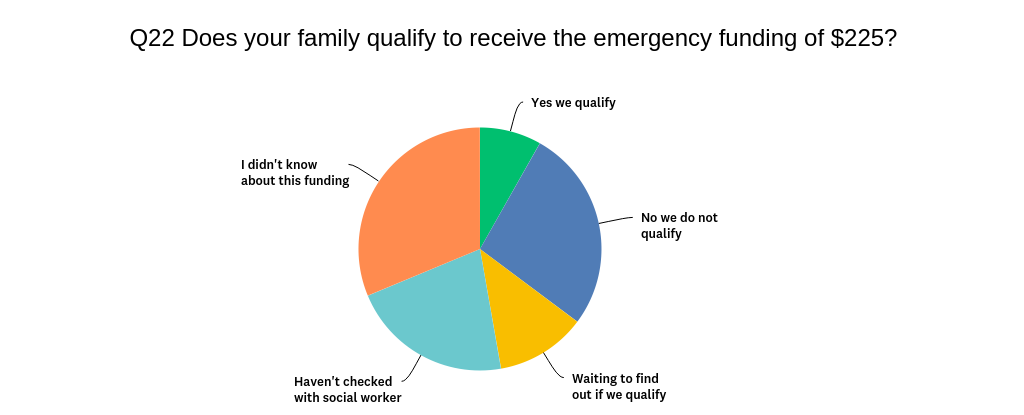
    From the families responding who receive CYSN support, 55% were not receiving respite funding before the pandemic. These are the people the Emergency Relief Support Funding was meant to help. However, when we asked which of the emergency measures families were able to access, only 6.8% said they were able to access the $225. Only 50 families out of 1055. The measures that are meant to support them are not working for these families.

    Pie chart of responses to question 22 on survey. Shows 5 options in different coloured and sized wedges representing responses.

    Figure – Question 22 – Does your family qualify to receive the emergency funding of $225?

    In addition, nearly 70% of those who already had respite funding before the pandemic said that they have not been able to use it during the pandemic. More flexibility is needed.

    Our organizations received 285 requests for advocacy support just from this survey, in addition to the many calls and messages we have been receiving since the beginning of the pandemic. 86% responded no to the question “Do you feel that your family is receiving care and support that is trauma-informed during the pandemic?” Families who were already under enormous pressure before the pandemic are in need of crisis support.

    The fifth most common response to “What do you need right now during the pandemic?” was that families need mental health supports, at 32.7% of respondents. This speaks to the challenges of the pandemic but also to the impact that inadequate supports is having on families.

    The pandemic is, according to respondents, amplifying the vulnerability of Indigenous families, reinforcing the need for a more intentional, culturally safe and responsive approach to providing support to all Indigenous families, and especially in remote and rural communities.

    We also want to acknowledge the 104 respondents who do not have a child who qualifies for CYSN services but were given an opportunity to tell us about their experiences with MCFD during the pandemic. Here are a few of their comments:

    We have never received any kind of services other than what we can get at school, so that means nothing during the pandemic. It is frustrating to be constantly left out of receiving help, especially as a single parent

    I’ve had multiple case workers over the years. One social worker who wen above and beyond to help and support and others once my family never ticked the right boxes we were left with no support. My son had a genetic mutation so rare it isn’t named yet and therefore doesn’t tick any boxes. Even though it looks like autism and comes with other delays. So frustrating without a “soul can label”. So sad to see not only my family fall through the cracks but so many other “grey area” kids.

    My son is a catagory D at school and was only attending part days with an ea. This was all the assistance I received for my child. Previous requests I have made to the ministry have resulted in minimal support and the ministry is quick to close my file. While my son is not diagnosed with autism his disabilities are severe and have significant impact on our family unit. What little support I did have I before covid is all gone.

    I hear that MCFD is cutting funding to the early hearing program and that Deaf Children’s Society will soon close due to lack of money. DCS has allowed my Deaf child to access their online preschool during the pandemic and that has been a huge support to our family as oral classes (mainstream kindergarten) by Zoom are quite frustrating for children with communication challenges, plus her school SLP services were cancelled. Finally the media is using ASL interpreters to ensure that Deaf Canadians are included in emergency planning, yet at the same time, the province of B.C. is about to force the closure of the only ASL preschool in the province. Many deaf children will now be without communication until they start kindergarten.

    My child with severe ADHD, anxiety and ODD is very difficult. There are no services for us before the pandemic and I wish this would change. Our family is falling apart with ruined relationships. I fear for what the future holds.

    The families who were already falling through the cracks are at a complete loss. My child with ADHD, SPD and DCD will NEED access to services including physiotherapy, occupational therapy, and counseling when things return to “normal” whatever that is. The loss of the tools we were using in place of funded services (recreational swim lessons, dance, gymnastics, teacher and class supports with social challenges etc) has been devastating to physical development and mental health.

    Our Recommendations:

    1. Provide broad flexibility in the use of funds families receive through different CYSN programs during the pandemic, following a family-centred approach.
    2. Support the resilience of families by easing their financial burden. Provide $525 per month (to be used at the family’s discretion) for the next 3 months to support families to stay strong and together.
    3. Clear communications
    • Provide clear, written guidelines around emergency pandemic measures and supports
    • Ensure effective, clear and responsive communication from social workers.
    • Publish explicit health and safety protocols based on recommendations from the Public Health Officer to allow families to access in-person supports.
    1. Recognize the many families of children and youth with disabilities left out of the CYSN funding structure and provide them with financial and other types of support during the pandemic.
    2. Work in collaboration with the Ministries of Finance and Social Development and Poverty Reduction to introduce the Child Opportunity Benefit earlier – May 1, 2020.

    A huge thank you to all of the families who were able to complete this survey! We appreciate you taking the time and providing your valuable feedback.
    _________________________________________________________

    BC Parents of Complex Kids:
    Do you have a medically complex child that receives funding from the provincial At Home Program (AHP) administered by MCFD? Would you like to connect with other AHP families to share knowledge and support, as well as join the collective effort to elevate our voices for change? Please email us at bccomplexkids@gmail.com and ask for an invitation to our online group.

    We invite you to follow us on social media for more ways to connect!

    BCEdAccess
    https://twitter.com/BCEdAccess
    https://www.facebook.com/BCEdAccess

    Family Support Institute
    https://twitter.com/FSIBC
    https://www.facebook.com/familysupportinstitute/

    Inclusion BC
    https://twitter.com/InclusionBC
    https://www.facebook.com/InclusionBC


  • Report on BCEdAccess Quick Covid-19 Inclusive Education Survey – Snapshot April 8th, 2020

    Introduction

    On March 30th, BC school and District staff went back to work in most Districts. They began, in varying ways, to follow the guiding principles cited by the Ministry of Education in their FAQ :

    1. Maintain a healthy and safe environment for all students and families and all employees. 
    2. Provide services to support children of essential workers. 
    3. Support vulnerable students who may need special assistance. 
    4. Provide continuity of educational opportunities for all students.

    As the first 2 weeks progressed, different both positive and challenging results began to emerge. On Thursday, April 8th, we ran a survey with the intention of measuring how parents and guardians of students with disabilities and complex learners feel about how things are going so far. We received 209 responses.

    PDF copy of this report

    We want to begin by recognizing the hard work by schools, Districts and the Ministry of Education, the unique nature of this challenge which no one has ever had to deal with before, and the fact that the Minister of Education has asked that School districts and independent school authorities put in place learning opportunities for students as soon as practically possible, no later than mid-April – and we have yet to arrive at that date. We have watched educators put together crisis learning while still managing families of their own. Many teachers and educational assistants also have children with disabilities. It’s a challenge unlike any we have ever faced before.

    Who is represented by this survey?

    This survey was shared in our Facebook community group which has about 2600 members. It was shared outside of the group by a few people so there was some limited response from families not part of the Facebook group. All responses are from families of children and youth with disabilities and complex learners in BC.

    The survey was open from noon until 9 pm and was completed for 209 individual students.

    • All grades are represented.
    • 35 districts – the Island, lower mainland, central, and the North are represented
    • Independent schools and Independent Distributed Learning schools, registered homeschoolers, At Home Program and more are represented

    13.5% asked to be contacted for additional advocacy support. In reading the details, several have urgent needs that have not yet been addressed by Education or the Ministry of Children & Family Development. 

    Some key findings:

    About 57% of respondents are still working in some way. Some are essential services workers, from front line health care to grocery store managers. Some are teachers trying to teach from home with children of their own. Many parents and guardians are working from home.

    Pie chart of responses
    Are you currently working at a paid or volunteer position?

    Over 3/4 of respondents have two or more children living at home with them. Nearly 27% of parents and guardians do not have a partner living with them. 

    Pie chart showing number of children respondents have at home.
    How many children do you have at home?

    Pie chart showing whether or not respondents have a partner living with them.
    Do you have a partner living with you?

    Schools and districts have reached many families since March 30th – nearly 87% of respondents had heard from someone by April 8th. Only 27.8% had heard from their child’s educational assistant, who is often the key connection they have at school and the one who spends the most time with them. Additionally only 6.7% had heard from a counselor. Several families have heard from specialists: occupational therapists,speech and language pathologists, learning support teachers, gifted coordinator, vision teacher, deafblind consultant, and more.

    Nearly 60% were offered educational support, while only 12.4% were offered mental health support. Some of those who have heard from someone have only received a generic email so far.

    Only 20% of respondents said they have been offered educational assistant support. Several have noted that their educational assistant has been offered work doing childcare for front line essential service workers, unfortunately in some cases before the school or district has checked in with their family. This is one of the top concerns of families at this time.

    Pie chart showing whether or not respondents have heard from their school or district.
    Have you heard from anyone at the school or district about your child with disabilities since March 30th?

    Technology Needs:

    Approximately 20 percent of respondents do not have reliable access to the internet/regular access to a device to connect to the internet. Other challenges cited include broken, incompatible and shared devices, different teachers using different platforms, high cost of internet service (including satellite only access), and students who cannot or will not use technology independently.

    Pie chart showing how many respondents have a device and reliable internet.
    Does your child have reliable internet access and regular access to a device to connect to the internet?

    “He is not able to access online learning due to his needs. He has a device and has access to the internet but he can’t use it independently.”

    “He gets overstimulated by technology (iPads, computers, TV) and not adequate for learning.” 

    “My three kids are sharing the iPad”

    Communication:

    So far, experience with communications from the school and/or district have been mixed. Many very positive experiences and many who are anxious because they have heard nothing so far, and everything in between. Those families who were already having challenges with advocacy are in some cases still having the same, while others have been pleasantly surprised.

    I am writing this because our school is amazing and has been in constant contact and offering support – I am picking up educational packages today for my two school aged kids (K and 2) and they are also putting together a package of specialized stuff that they are making right now even though I offered to do it. Our teachers have all called, we did a Zoom meeting before it was banned, we did FaceTime with our amazing EAs, and we are working on Microsoft Team. Our Grade 2 teacher is posting online class videos for the kids and also says do what you can and don’t worry about it. I fully realize that our school is an abnormality and I hope other schools are able to see what is possible. We specifically chose this school (out of catchment) because of the amazing staff.”

    “We were having daily video communications with his EA and then the District put a stop to that, which resulted in an increase in anxiety and non-compliance and vocal protests. The teacher reached out via email the next day to ask us to set up MS Teams. The principal called a few days later stating that his EA was going to be doing childcare for essential workers’ children so they assigned a different support person to my son who spent the last two years building the relationship with his current EA.”

    “The school is great but there’s not relevant support being offered for my severely disabled child.”

    Educational Assistant Support:

    We asked whether families felt their child needed the support of an educational assistant, and how and why. This generated many responses. The majority of respondents have not been offered this support. Families told us that educational assistants are needed by students for personal care, sign language, literacy and numeracy support, self-regulation, executive function support, and more.

    Families said that the need for that consistency of connection between children and youth and their educational assistants during this traumatic time is greater than ever than ever.

    Pie chart showing how many respondents' children have been offered educational assistant support
    Has your child been offered Educational Assistant support?

    He is having a hard time adjusting to everything but his EA has been wonderful with him and we have been working with her since Monday. “

    ASD/Complex learner.. Has 1 to 1 support at school. I am unable to support as I am dealing with my own mental health issues and am on disability. The schools needs to guide him in whatever capacity, as I don’t have the energy.”

    “Yes. He had a 1:1 EA while in school and needs to continue that relationship for continuing his learning. I am not an educational professional and he needs that support for certain learning activities.”

    My son had bell to bell EA in school and cannot navigate instructions on his own. He has a big detailed support plan at school and several staff members who help through the day. I just cannot do it all myself while also working full time, I find it all overwhelming so I can only imagine how he feels.”

    “For all academic output – math, reading, scribing, planning, organizing, comprehension of material/breaking down complex information. Our child has challenges with executive functioning and emotional regulation.”

    “He has trouble reading & writing. His self esteem is low & he thinks he’s stupid. Tutoring for funds to pay for an online program that works for him would absolutely make a marked difference in his successes next school year. Hi current EA has made such amazing progress & now he loses it. No support is available because he’s not disabled enough.”

    “He wants to do what his peers are doing and is very aware he cannot right now.”

    “EA is available online. Child only works through physical connection. Can’t deal with online connection. Too much of an adjustment.”

    “We use full body communication and the EA knows his learning needs best.”

    “My child resists me as his teacher. I am his parent. He needs prompting, direction, OT, reinforcement. I can’t accomplish all these roles. A simple art exercise resulted in tears. My child needs his EA.”

    What do families need right now?

    Finally, we asked the question, “What do your child and family need from schools during this pandemic?” We received too many responses to list. Here is a summary of just a few commonly cited needs:

    • Counselling/mental health support
    • Respite
    • Curriculum, inclusion, community & connection
    • Patience and LOW or NO expectations
    • To not be forgotten about

    In Conclusion:

    As an advocacy organization, we see one of our roles as checking in with our community members and providing data to stakeholders and the public as part of the ongoing conversation around the needs of families.

    This report establishes that education has responded swiftly to the pandemic and has had some success in supporting families of students with disabilities and complex learners. The report also shows that there are ongoing large gaps in meeting the needs of families equitably within this crisis learning environment. We implore the government to look at this data in full and make necessary adjustments in line with the guidance already provided to Districts to ensure all families’ needs are being met. The Ministry needs to communicate these gaps and the Ministry of Education’s expectations around closing them clearly and directly with all Districts.

    Essential service workers are vital and the support for their children are of equal importance to those students who are ‘vulnerable and need special assistance’. It has been disconcerting for families to know their EAs have been taken away without notice to care for other children, in particular because of the need to keep their child connected to the familiar supports they would have access to in the classroom. While we understand the uniqueness of the circumstances, we must react swiftly under these same circumstances to advocate for these supports to continue before they are lost. The first and fourth guiding principles include “all students.” BCEdAccess exists to continually remind that children and youth with disabilities and complex learners are part of the “all” in those statements.

  • Urgent Action on COVID-19 Needed For BC Children, Youth and Adults With Disabilities and their Families

    This morning we sent a letter to the Premier and his cabinet ministers. I would be surprised if they have even had a chance to read it. Things are moving very quickly with this crisis. Because of the speed with which things are changing, we felt it was important to publish the letter even though the government has not had time to respond, so that more of the public is able to think about these urgent actions which need to be taken to support children, youth, and adults with disabilities, and their families.  Solutions are needed. We appreciate the efforts of the BC and Canadian governments and want to help them by providing information, insight and ideas from the perspective of our families.

    Here’s the letter in it’s entirety, and a pdf as well.

    Urgent Action For BC Children, Youth and Adults With Disabilities and their Families


    March 19, 2020


    BCEdAccess acknowledges these are unprecedented circumstances that impact us all. As we come together in support of the BC government’s actions to stop the spread of Covid-19, we would like to highlight the urgent need for an immediate action plan for an inter-ministerial, coordinated and inclusive approach for children, youth and adults with disabilities, and their families and caregivers.


    It’s important to note that these are not concerns about learning at this time. Those are also worries that families are feeling and we look forward to providing feedback on that matter at a later date, but for now we are looking strictly at emergency measures that need to be taken with respect to children, youth and adults with disabilities currently in the education system, as well as those younger than school age, and those who have moved on from the K-12 system as adults.


    The three most urgent issues are these:


    Critical home and nursing care

    Mental health and trauma

    Family violence


    A non-exhaustive list of the items we see a need for include:


    • A communication plan that includes information accessible in ASL, for screen readers, in plain language with images to illustrate key concepts, and closed captioning to be used in public broadcasts and any videos shared. Information is vitally needed with regard to guidance around different health conditions and disabilities and the impact of COVID-19
    • A financial plan that includes increases to people with disabilities and welfare payments, extending autism funding beyond birth month for those who will otherwise not be able to use all of their funding in time and will lose it, and advocacy to increase the federal disability tax benefit
    • A health and supports plan that includes prioritizing home care and supports, as would be provided typically at school and/or in the community, and rapid scaleup of health care workers to understand how to care for people with disabilities
    • A mental health care plan that includes supports for individuals with disabilities and also for their caregivers. Including counselling services in the Medical Services Plan, providing a dedicated hotline for people with disabilities – adults and children and youth, as well as for families, and guidelines for service providers who will be providing care in the homes of people with disabilities
    • A plan to provide supports and qualified care around family violence 
    • Groceries, prescriptions and other supplies to be prioritized deliveries for people with disabilities and families with children and youth with disabilities at home – currently those who need it most are not able to access because stock is depleted by in person shopping, even if they did have the financial resources to feed themselves and their families. As we all know, many do not have those resources.
    • A plan to address the issues of lack of and unstable housing, congregated settings and precarious employment for people with disabilities.
    • Caregiver supports – paid time off to care for children and youth and adults with disabilities
    • A plan for workers currently supporting adults or children and youth with disabilities, and continuity of service should they become ill. We can pull in students currently in training from ECE, EA and social work programs. We need to provide additional training in infection control to workers, along with information about trauma and other mental health concerns, as well as cross training in physical and emotional support needs. 
    • A financial and safety plan for those workers – continued pay for specialist services while school is out, priority access to personal protective equipment, 


    It would be helpful for our families if information on how to connect in community for local support and exchange of goods and services was compiled and distributed. We will also need to have a separate conversation about educational supports during this time, and a further conversation about supports that will be needed when attempting to transition back to whatever the new ‘normal’ looks like down the road. This will be challenging for everyone but more so for some disabled children, youth and adults. 


    Here are just two of the many anxious comments by parents and guardians in our community:


    Just managing the changes of spring break is enough of a challenge in our household. I don’t know how we’ll handle additional weeks off, especially without regular activities. School provides not only education and social training, but respite for us. My eldest is already responding explosively and we’re having to isolate his younger brothers for safety – the idea of us all being stuck together for a month without respite or support is quite frightening.


    I would really like to know the risk of complications for those of us with kids with underlying medical conditions.

    Such as Epilepsy, Chromosome Abnormalities, and compromised immune system from cleft lip and palate.


    Home care and supports will be needed for both children and older youth and adults with a disability, regardless of whether the parent/guardian is at work or at home. Caregiver burnout, mental health strain and domestic abuse as a result of the isolation and stress, can be avoided with additional support. It will take the rapid coordination of all the Ministries working with organizations like SelfAdvocacy.net, Inclusion BC, the Family Support Institute, and more to create a coordinated plan for children, youth and adults with disabilities and their caregivers.


    As always we appreciate your willingness to accept input and again we want to acknowledge the unprecedented nature of our current situation and the hard work and swift decision-making going into the management of this global crisis. We are offering our time and support to help in any way we can.


    Regards,


    Tracy Humphreys

    Chair, BCEdAccess Society


    About the BCEdAccess Society:

    BCEdAccess champions and supports children and youth who have disabilities and who are

    complex learners to reach their full potential in BC education, and in all aspects of their lives.

    This is achieved through supporting families, sharing information, providing education to

    families, allies, professionals and students, providing community engagement and awareness,

    and other activities to promote equitable access to education and inclusion for all.