We reposted our important BCEdAccess blog written in 2023 by Tracy Humphreys and started a conversation in our Facebook group about people’s feelings about Pink Shirt Day.
Many families expressed concerns about how Pink Shirt Day functions as a declaration that replaces the work it claims to represent: schools distribute shirts, take photos, post to social media, and generate the appearance of a community that takes bullying seriously, which is precisely what allows the deeper, ongoing harm to continue. It feels performative for many.
“I think the idea of it started with good intent, its lost its meaning. We don’t need 1 day to practice kindness, when all the other days don’t matter. Teachers are exhausted with policing kids, and they turn a blind eye to bullying “as long as nobody is physically hurt, ignore it and move on”. As a mom with a child who is relentlessly bullied by specific children, and nothing happens, it actually angers me that people wear pink and pretend like they’re acknowledging something that is truly rampant.” – Anonymous
Pink Shirt Day started out because of homophobia. Teens rallied with solidarity to show support for a younger male teen who was being bullied with homophobic insults for wearing a pink shirt. The two older grade 12 teens bought multiple pink shirts and distributed them for many others to wear as a sign of solidarity. Pink Shirt Day has evolved into a day about kindness, and many schools have erased the original discrimination the day stands for that required a call to action.
Bullying someone who is connected to a protected ground under the Human Rights Code is discrimination. Parents/caregivers and students can file a human rights complaint for bullying. The most noteworthy case of this is Jubran v. Board of Trustees, 2002 BCHRT 10 (CanLII).
From this case:
[109] The Court held that schools are:
…an arena for the exchange of ideas and must, therefore, be premised upon principles of tolerance and impartiality so that all persons within the school environment feel equally free to participate. As the board of inquiry stated, a school board has a duty to maintain a positive school environment for all persons served by it. (at para. 42)
[116] As a matter of legislation and case authority, there is a legitimate state interest in the education of the young, that students are especially vulnerable, that the School Board may make rules establishing a code of conduct for students attending those schools as part of its responsibility to manage those schools. Given this, and the quasi-constitutional nature of the Code, I find that the School Board has the duty to provide students with an educational environment that does not expose them to discriminatory harassment.
[118] Having found that the School Board contravened s. 8 by failing to provide a learning environment free of discrimination, the burden then shifts to the Board to establish that the measures it took constitute a bona fide and reasonable justification. Once the harassment is made known to the school, the administration had an obligation to act on the specific complaints. Although the School Board argued that there was no evidence that indicated which steps it had taken were insufficient, it has the burden of showing that the steps it took were appropriate.
********
The courts have already been clear about this. BC’s Human Rights Tribunal has ruled that when harassment is connected to a protected ground, it is discrimination, and schools have a duty to act — specifically, demonstrably, once they are aware. A pink shirt does not meet that duty.
Here are parents’ feelings and experiences around Pink Shirt Day:
********
One parent reports their child says, “They say it’s useless and just something they’re “told” to do by the school. No difference at all in who gets bullied.” – Anonymous
“In my experience, bullying is very much tolerated in public school and there is no actionable recourse for the parents of the bullied child.” – Anonymous
“Pink Shirt Day is part of a larger marketing apparatus that schools deploy to invoke a patina of inclusion while structurally excluding children by trampling their human rights.” – Anonymous
“Kids just don’t get bullied by others kids. They also get bullied by educators , and others in position of power . This happens from early level of education to post secondary.” – Anonymous
“My biggest beef with Pink Shirt Day programming is that it only addresses students as being in the roles of victim or bystander. They never address students as if they might be in the role of the bully. This leads to all students seeing themselves as victims/bystanders and never gives anyone the tools to recognize bullying behaviours in themselves or how to change or get help. Bullies are always framed as the “other”, as the “bad guy”, and nobody wants to see themselves that way, so there is never an opportunity or support given to those who might need to change their path. We will never solve bullying with this approach.” – Anonymous
“I used to be behind pink shirt day but not anymore. The same kids wearing the pink shirts were the same kids telling my kid it was better if he killed himself. Also as another parent said ‘my kids got bullied for not wearing a pink shirt.” – Anonymous
“Bullies (of all ages and roles in the school) wear the pink shirt, high-five each other, and keep on bullying.” – Anonymous
“My son was bullied (physically) on a pink shirt day one year in high school. The principal and I had a VERY interesting discussion. This was not the first time he was bullied. He loved learning at school but was often a target of bullying due to his additional needs. Kids in class would intentionally make noise, tapping on desks, tapping feet on table legs. Then there were the students like this kid shoving him purposely into lockers etc. This was all compounded by his physical sensitivity so getting brushed by someone accidentally in the hallway triggered a response in him.” – Anonymous
“Bottom line – the kid was still at school the next day and was a regular bully to kids and seemed to get little or no consequences. So what message does this send to a kid being bullied, we don pink shirts one day of year but kids being bullied don’t truly feel supported.” – Anonymous
“Bullying is rampant. Violent incidents are not adequately addressed..no safety plans made for victims of assault etc. Schools only make safety plans for staff, is what I have been told. Kindness needs to be the focus every day.” – Anonymous
“One thing that I have heard countless times from parents reporting bullying to schools, parents sharing this on social media platforms connected to a school, and me approaching the school directly is that “we don’t really like to use the word bullying” as it is very strong word that is typically not applicable, but parents like to use it to raise alarm bells. This is systemic gaslighting. I always ask why this is the case because when it walks like a duck and talks like a duck, should it not be called a duck? The response is gaslighting version of this: children don’t typically intend to bully, so we don’t use that word to identify children. Similarly, when I question resistance to naming racism, I am often told: it was not the intent of the child to be racist (which is clearly a way to gaslight me and suggest that I am over reacting when intent is present when someone uses the N word, tells a child they are dirty because their skin is dark, mocks their name (associated with their ancestral community), told that this school isn’t for racialzed kids, go back to where you came from, racial slurs, using stereotypes, obvious exclusion, etc). One of my child’s earliest observations about social dynamics were about how she and one of her friends were always put into their ancestral communities. Both children are non-European. Often this led to a host of stereotypes being applied to these 2 children. My child’s friend left the school because of the ongoing racist bullying. Bullying often incorporates any vulnerability to oppress. And when children have more than one vulnerability, the bullying is often compounded. For kids who are differently abled, and are queer or belong to IBPOC communities, there are more ways to oppress, and bully.” – Anonymous
“My kid got bullied for not wearing a pink shirt… it doesn’t change anything.” – Anonymous
“I was an educator working in schools when the pink shirt phenomenon started. I think it felt very different in the early days when we knew the origins very clearly and it was on the news – the kid that was bullied and the grade 12s that stood up for him. I was a grade 12 Vice Principal at the time and it was very much a conversation starter for the responsibilities they had. Then I moved to be an elementary school principal and although my staff had creative ways for kids to be involved in the day, it just felt like one of those days we did, even at the start. All of these things people have said here are true – the bullies are wearing pink shirts, some students, some staff.” – Anonymous
“Pink shirt day isn’t supposed to be blanket be kind / anti bullying. It’s actually about combating homophobia and misogyny….so ya.” – Anonymous
“We refuse to Acknowledge PINK TSHIRT DAY. If you need a day once a year to be nice there is something wrong. It’s a money making BS.” – Anonymous
“My ASD son said pink shirt day is BS and it just makes the bullies feel like they are good people by wearing a pink shirt. – Anonymous
“I refused to buy my kids pink shirts and the school actually had some “extras” they sent my kids home with.” – Anonymous
“Pink shirt day is simply a day so school boards can say they are addressing the bullying issue…” – Anonymous
*******
What families describe in this piece is not a kindness problem. It is discrimination. Harassment connected to ableism, racism, to sexuality, to gender expression — each one is tied to a protected ground under BC’s Human Rights Code, and each one triggers a legal duty that schools are required to meet.
Being safe, both physically safe and psychologically safe, is paramount for any kind of learning to take place. Feelings of safety need to be prioritized. Bullying is layered and a complex topic; talking to kids once a year about kindness isn’t enough. We as a society need to do more to figure out how bullying can be addressed in a way that is fair and healing for all involved. Surely, this is an area that requires more attention. Until this becomes more of a focus for schools, Pink Shirt Day will continue to feel nothing but performative for many of our families. What these families are describing is not a failure of kindness. It is a failure of duty, structural and sustained, and their testimonies are the evidence.
(Permission to share) – Text below picture
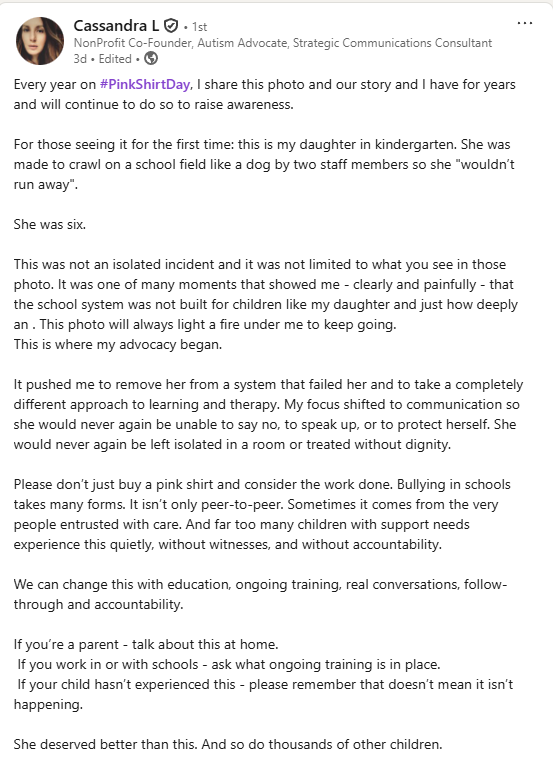
(Text on Picture above)
Every year on #PinkShirtDay, I share this photo and our story and I have for years and will continue to do so to raise awareness.
For those seeing it for the first time: this is my daughter in kindergarten. She was made to crawl on a school field like a dog by two staff members so she “wouldn’t run away”.
She was six.
This was not an isolated incident and it was not limited to what you see in those photo. It was one of many moments that showed me – clearly and painfully – that the school system was not built for children like my daughter and just how deeply an . This photo will always light a fire under me to keep going.
This is where my advocacy began.
It pushed me to remove her from a system that failed her and to take a completely different approach to learning and therapy. My focus shifted to communication so she would never again be unable to say no, to speak up, or to protect herself. She would never again be left isolated in a room or treated without dignity.
Please don’t just buy a pink shirt and consider the work done. Bullying in schools takes many forms. It isn’t only peer-to-peer. Sometimes it comes from the very people entrusted with care. And far too many children with support needs experience this quietly, without witnesses, and without accountability.
We can change this with education, ongoing training, real conversations, follow-through and accountability.
If you’re a parent – talk about this at home.
If you work in or with schools – ask what ongoing training is in place.
If your child hasn’t experienced this – please remember that doesn’t mean it isn’t happening.
She deserved better than this. And so do thousands of other children.
 BCEdAccess Society